
Smoking and alcohol consumption are declining, while obesity continues to rise: this contrast defines the recent evolution of the main health risk factors in Spain. In 2020, 20% of the Spanish population smoked daily and only 9% drank alcohol every day, compared with 32% and 20%, respectively, in the 1990s [Fig. 1]. At the same time, leisure-time physical activity has increased significantly, doubling over recent decades from 13% in 2001 to 26% in 2020. Among younger people, these trends are even more pronounced. In 2020, just over 1% of those aged 15 to 24 consumed alcohol daily, and only 15% smoked with the same frequency. Such low levels suggest that the changes that began in earlier generations may intensify in the future, reinforcing the decline in tobacco and alcohol use. However, not all indicators are moving in the same direction. Obesity continues to increase and now affects 16% of both the adult and child population—up from just 7% in the late 1980s. If this trend persists, one in four children could be living with obesity by 2050. This is a clear warning sign that calls for looking beyond the progress made so far and paying close attention to emerging health risks.
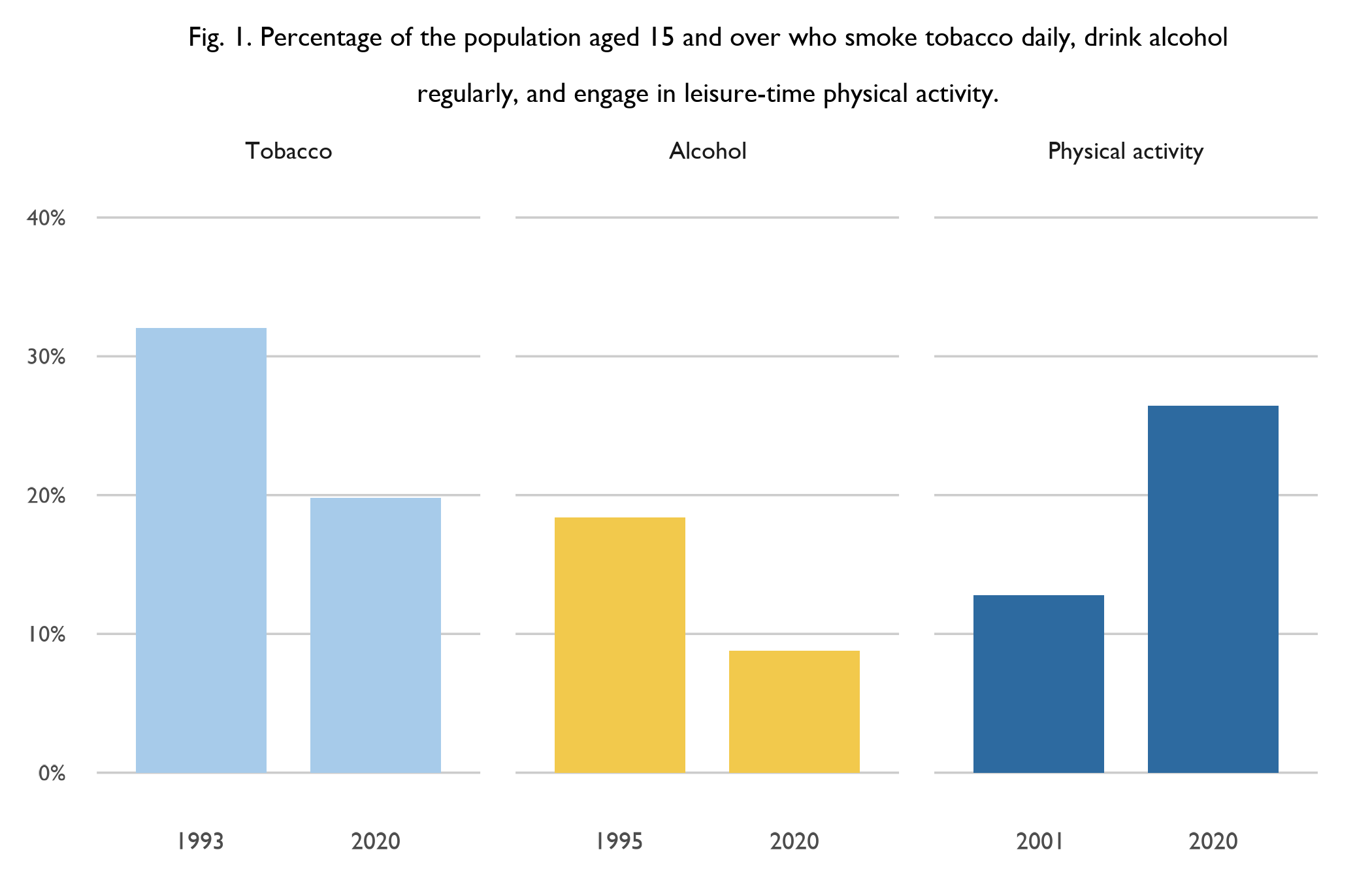
Source: own analysis based on data from the Spanish Ministry of Health.
Behind this increase lie profound changes in everyday life. The rise of office-based work and the growing amount of time spent in front of screens have expanded sedentary lifestyles, with around 40% of people now sedentary in their main daily activity. At the same time, especially in lower-income households, the combination of limited access to practical nutrition information, tight budgets, and a food environment where the cheapest options are often the most calorie-dense makes it harder to adopt healthy diets. Together, these factors have contributed to the continued rise in obesity.
If these dynamics continue over the coming decades, the challenge will be twofold. On the one hand, the health risks linked to alcohol and tobacco use are likely to keep declining, provided that the progress achieved so far is maintained. On the other hand, obesity may become one of the major structural challenges for public health. Preventing this outcome will require policies that promote active mobility and improve the availability, affordability, and appeal of healthy food options.
Spain has an institutional ecosystem capable of driving this transition. The Health Promotion and Prevention Strategy within the National Health System and the National Strategic Plan for the Reduction of Childhood Obesity provide a solid foundation on which to scale up and better coordinate efforts. Transforming environments such as schools, neighborhoods, and municipalities to make healthy choices easier and reduce inequalities can deliver decisive impacts, from lower rates of obesity and other risk factors to reduced morbidity and mortality linked to diseases such as cancer, heart disease, and chronic lung conditions.
For further details, see:
Alto Comisionado contra la Pobreza Infantil. Plan Estratégico Nacional para la Reducción de la Obesidad Infantil (2022-2030)-En Plan Bien. Madrid, 2022; Boletín Oficial del Estado. Real Decreto 315/2025, de 15 de abril, por el que se establecen normas de desarrollo de la Ley 17/2011, de 5 de julio, de seguridad alimentaria y nutrición, para el fomento de una alimentación saludable y sostenible en centros educativos. Madrid, 2025; Darmon, Nicole and Adam Drewnowski. “Contribution of food prices and diet cost to socioeconomic disparities in diet quality and health: a systematic review and analysis.” Nutrition Reviews, 2015; Gasol Foundation. PASOS. Physical Activity, Sedentarism, Lifestyles and Obesity in Spanish Youth. Gasol Foundation Europa, 2023; Hemmingsson, Erik, et al. The social origins of obesity within and across generations. Obesity Reviews, 2023; Kerr, Jessica A., et al. "Global, regional, and national prevalence of child and adolescent overweight and obesity, 1990–2021, with forecasts to 2050: a forecasting study for the Global Burden of Disease Study 2021." The Lancet, 2025; Ministerio de Sanidad. Portal Estadístico. Área de Inteligencia de Gestión. Encuesta Nacional de Salud de España (ENSE). Serie histórica. Estilos de vida y prácticas preventivas. Consumo diario de tabaco y consumo habitual de bebidas alcohólicas. Porcentaje según sexo y grupo de edad; Ministerio de Sanidad, Servicios Sociales e Igualdad. Estrategia de promoción de la salud y prevención en el SNS. En el marco del abordaje de la cronicidad en el SNS. Madrid: Ministerio de Sanidad, Servicios Sociales e Igualdad. Centro de publicaciones, 2013; Montero-Torreiro, María Fe. "Evolución de la prevalencia de sedentarismo en la población española entre los años 1987 y 2020." Medicina Clínica, 2024; Peral-Suárez, África, et al. "Lifestyle Clusters of Diet Quality, Sleep, and Screen Time and Associations with Weight Status in Children from Madrid City: ENPIMAD Study." Nutrients, 2024; and, Soriano, Joan B. et al. "La carga de enfermedad en España: resultados del Estudio de la Carga Global de las Enfermedades 2016." Medicina Clínica, 2018.
The data shown in the chart are available at:
Ministerio de Sanidad. Portal Estadístico. Área de Inteligencia de Gestión. Encuesta Nacional de Salud de España (ENSE). Serie histórica. Estilos de vida y prácticas preventivas. Consumo diario de tabaco y actividad física moderada o intensa en tiempo libre. Porcentaje según sexo y grupo de edad ; y Prevalencia (%) de consumo de alcohol en España. Año 2020. Tramo temporal: A diario en los últimos 30 días. Edad 15-24; and, Plan Nacional sobre Drogas. "Encuesta domiciliaria sobre uso de drogas 1995. Principales resultados." Ministerio de Sanidad.
Data on the prevalence of obesity among the adult population and among children (ages 6 to 9) are available at:
Feijoo, Laura, et al. "Prevalencia de la obesidad en España y en sus comunidades autónomas, 1987-2020." Revista Española de Cardiología 77, n.º 10, 2024; Recuero Carretero, María Cristina, Carmen Arias López and Cristina Sepúlveda Villafranca. Estudio ALADINO 2023. Estudio sobre la Alimentación, Actividad Física, Desarrollo Infantil y Obesidad en España 2023. Madrid: Agencia Española de Seguridad Alimentaria y Nutrición (AESAN) y Ministerio de Derechos Sociales y Agenda 2030, 2024; and, Ministerio de Sanidad. Portal Estadístico. Área de Inteligencia de Gestión. Encuesta Nacional de Salud de España (ENSE). Serie histórica. Estilos de vida y prácticas preventivas. Obesidad. Porcentaje según sexo y grupo de edad.