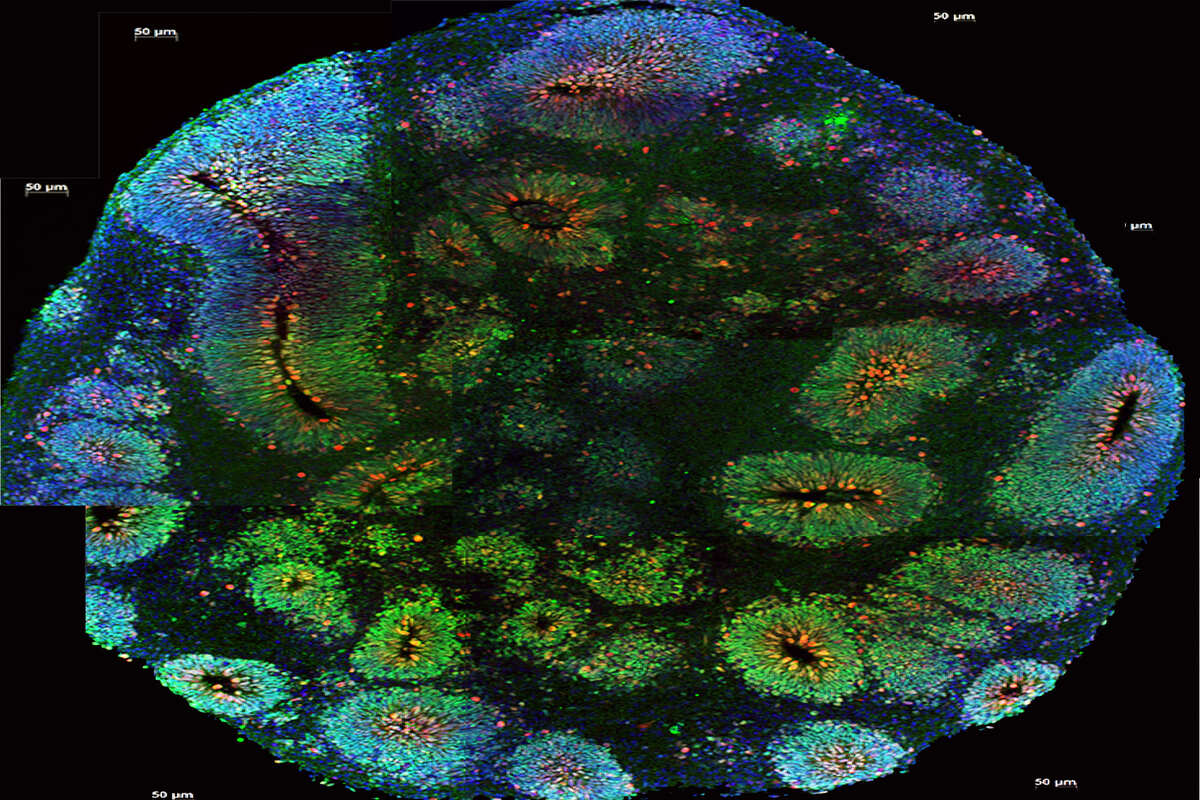
Biomedical research depends on good models in which to study disease. But these models often fall short. For decades, drug development has relied above all on laboratory animals and on flat (or adherent) cell cultures, which reproduce human biology only approximately. Many of the compounds that pass these tests end up failing in people. The underlying problem is that none of these models is actual human tissue. Hence the growing interest in models that more faithfully reflect human biology. Among the most promising are organoids, millimetre-scale three-dimensional structures that reproduce part of the architecture and function of an organ or tissue. As they mature, they could replace much of animal experimentation and take on a central role in the early stages of drug development.
Given the right biochemical cues, stem cells can self-organise into miniature organs such as the liver, kidney or retina. These are not complete organs — they lack vascularisation, an immune system and many of the interactions found in a living organism — but they capture human biology far better than a flat culture, making it possible to study how a disease progresses, test drugs and detect toxic effects before a compound ever reaches a patient.
One of the most mature applications is organoids derived from cancer patients. Grown from a biopsy or from tissue removed during surgery, they retain much of the genetic makeup and heterogeneity of the original tumour — not an idealised version, but that particular person's tumour. This fidelity makes them a powerful model for understanding why tumours resist treatment and, above all, for personalised medicine: a patient's organoids can be exposed to dozens of drugs to anticipate which one will work before it is ever administered. In cancers of the digestive tract, and especially colorectal cancer, their response already predicts how the patient will respond in the clinic with notable reliability. On top of this comes their role in drug discovery — biobanks of tumour organoids allow candidate compounds to be tested against hundreds of different tumours — along with early efforts to combine them with immune cells to test immunotherapies.
Beyond these uses, still-emerging frontiers are coming into view. The nearest is regenerative medicine, using organoids to repair damaged organs before a transplant — an avenue that remains preclinical but could help ease the shortage of donors. Another line of research is biocomputing: using brain organoids, wired to a chip through electrodes, as living processors, taking advantage of the fact that a network of real neurons consumes far less energy than a conventional computer. Some companies already market platforms of this kind, some even accessible remotely, and one experiment showed cultured human neurons learning to play a classic video game.
None of this is free of significant limitations. The lack of vascularisation restricts how large organoids can grow and how far they mature, the absence of immune components leaves out processes central to many diseases, and batch-to-batch variability hampers reproducibility and the move from the lab to clinical routine. Added to this are ethical and regulatory questions that remain open, above all around brain organoids and the possibility — not demonstrated to date — that they might develop meaningful forms of activity.
At the same time, the regulatory framework will need to evolve at the same pace as the technology. Until now, organoids have served mainly as a complement to animal models rather than a recognised replacement. That is beginning to change: in June 2026 the European Commission presented a roadmap to progressively phase out animal testing in the safety assessment of chemicals and pharmaceuticals, within the category of new approach methodologies (NAMs), in which organoids play a central role. Spain is well positioned for this shift: it has a network of research groups across the country, coordinated through a state platform at the Instituto de Salud Carlos III, and the Ministry of Science already funds organoid development among its research lines. There is a long way to go, but the direction is set — and there are already signs that it works.
Ambitious as it is, the horizon these models outline is not a distant one. The first were cultured more than fifteen years ago; today there are biobanks of patient-derived organoids, and by mid-2025 around 190 clinical trials were based on them. The ability of a few cells to rebuild part of a human organ in miniature is becoming one of the most promising avenues in biomedical research.
For further information, see:
Duxin Sun, Wei Gao, Hongxiang Hu, Simon Zhou, Why 90% of clinical drug development fails and how to improve it?, Acta Pharmaceutica Sinica B, Volume 12, Issue 7, 2022, Pages 3049-3062, ISSN 2211-3835, https://doi.org/10.1016/j.apsb.2022.02.002.
FDA, US. Roadmap to reducing animal testing in preclinical safety studies. US FDA: Washington, DC (2025).
González-Sastre, R., Foti, L., Maeso, L. et al. (2025). Human cerebral organoids: Complex, versatile, and human-relevant models of neural development and brain diseases. Neural Regeneration Research, 21(3), 837–854. https://doi.org/10.4103/NRR.NRR-D-24-01639.
Álvarez-Varela, A., Novellasdemunt, L., Barriga, F.M. et al. Mex3a marks drug-tolerant persister colorectal cancer cells that mediate relapse after chemotherapy. Nat Cancer 3, 1052–1070 (2022). https://doi.org/10.1038/s43018-022-00402-0.
Garreta, E., Moya-Rull, D., Centeno, A. et al. Systematic production of human kidney organoids for transplantation in porcine kidneys during ex vivo machine perfusion. Nat. Biomed. Eng (2025). https://doi.org/10.1038/s41551-025-01542-1.
Brett J. Kagan, Andy C. Kitchen, Nhi T. Tran et al. In vitro neurons learn and exhibit sentience when embodied in a simulated game-world, Neuron, Volume 110, Issue 23, 2022, Pages 3952-3969.e8, ISSN 0896-6273, https://doi.org/10.1016/j.neuron.2022.09.001.
The ISCIII Biobanks and Biomodels Platform.
Image credit: Human brain organoid. Vaccarino Lab, Yale University (NIH Image Gallery).